Learn the mathematics.
Workshops and reading groups give us room to slow down, ask questions, and build stronger foundations.
A student-owned association committed to excellence in data science, quantitative finance, and applied AI — building rigor into work that actually ships.
Explore enode ↓We are a student-owned collective working across data science, quantitative finance, and applied AI.
Workshops to understand the mathematics. Projects to put it to work. Conversations with people who have gone further.
Meet enodeProjects, workshops, and contributions.
Some finished. Some still taking shape.
Workshops, reading groups,
and visiting perspectives.
| Mon | Tue | Wed | Thu | Fri | Sat | Sun |
|---|
Engagement, initiative, and the willingness to keep going.
That is where membership begins.
We are students who want to keep learning beyond the curriculum. At enode, we work through the mathematics, build projects, and give our questions time in the company of others.
enode began with something missing. At ESADE, students drawn to finance, consulting or marketing had clubs where they could go further than the syllabus. Those of us who wanted to spend our time on data science and mathematical finance had nowhere like that. I started enode to make that space, and the first people to believe in it were classmates from the BSc in Artificial Intelligence.
None of us arrived knowing much. What we shared was a list of things we wanted to understand properly, and a hunch that it would be easier, and a lot more fun, to work through them together.
Most of what enode is today was built by people who came later: members who taught what they had only just learned, lecturers who gave us their time, students on another campus who started AI4Law. The association is theirs as much as anyone’s.
What we have learned is simple, if not easy. Understanding comes from repeated attempts. What feels impossible one month becomes ordinary the next, if you keep returning to it. And it helps to have someone beside you who is stuck on the same problem.
No one can do the learning for you, but we can make room for it: share what we know, ask the questions that feel too basic, and help one another begin again. If you leave with stronger foundations, something you are proud to have built, and a few people who think the way you do, enode will have done its job.
Keep showing up. Keep trying. Press on.
— Ro Sastre, first president
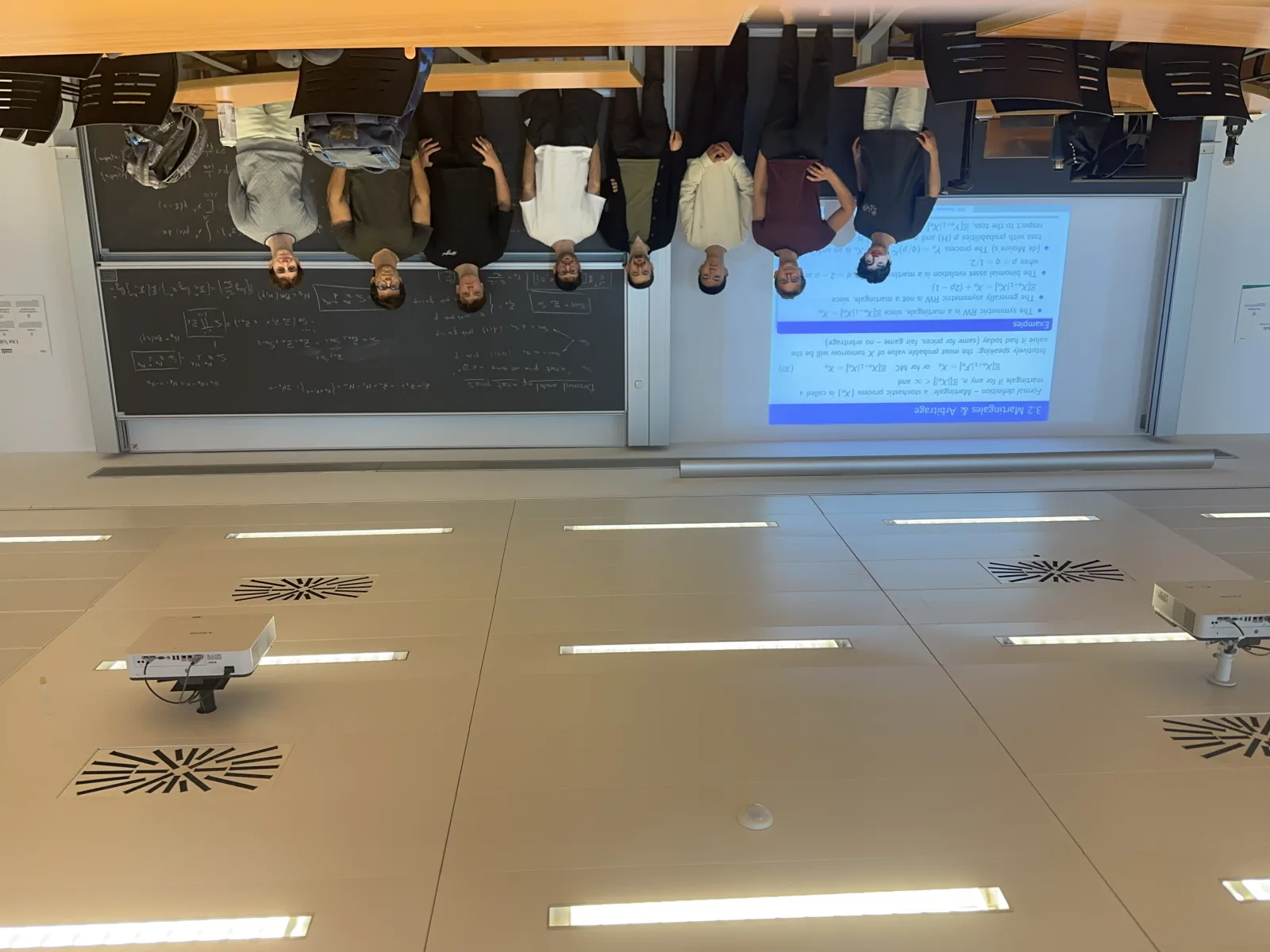
Workshops and reading groups give us room to slow down, ask questions, and build stronger foundations.
We turn ideas into code, research notebooks, and projects we can examine, improve, and share.
Members teach what they have learned. Speakers, practitioners, and alumni join the conversation through localhost.
A short, unpolished record. Most of it was somebody’s first attempt.
A handful of BSc in Artificial Intelligence students, a classroom, and a list of things we wanted to understand properly.
A semester of workshops with Marius Oltean. They later became an official ESADE elective for STEM-oriented students.
Law students bring a second campus and a different set of questions.
Adrià Garcés leads five sessions, from random walks to Itô calculus, with labs in Python.
Research members join the Esade MBA AI Bootcamp as teaching assistants.
Second edition, fourteen Tuesdays. See the programme
A co-authored paper with the ICSO research group, and a few projects we learned more from than we shipped.
Our board and department leads make room for the work.
These profiles are placeholders while this year’s team is confirmed.
Research and Quant meet at ESADE Sant Cugat, with workshops in Aula 001 and 005. AI4Law brings the legal perspective from ESADE Pedralbes. We welcome students across disciplines.
Bring something you want to understand. There is room to begin.
Join enode
Based at ESADE Sant Cugat. The how and why beneath modern computing. Mathematical foundations, the mechanics of code, and projects that make understanding visible.
We want to understand what our tools do, why they work, and where they fail. Our long-term aim is a collective repository of workshops and projects that prepares members for technical work and further study.
Maximum likelihood, change of variables, transformation of densities, optimization, and automatic differentiation.
Embeddings, transformers, mixture density networks, diffusion, graph neural networks, and applied ML. In the past, a group of members rebuilt GPT-2, GPT-3 and Llama from scratch, end to end; rebuilding a system gives its abstractions something concrete to stand on.
Our early systems work explores memory, performance, and lower-level code. Learning to read C++ and Rust, and to understand what sits beneath a training loop.
If you have mastered a library or built a side project, bring it into the room. Teaching is another way to test understanding.
In the classroom · October 2026
Research members as teaching assistants
For two intensive days, members of the Research department joined the Esade MBA classroom as teaching assistants. Alongside the professors, we supported practical deployment sessions in which MBA students built, tested, and deployed functional AI tools.
Explaining a system to someone who needs it to work is its own kind of test. The class brought energy, problem-solving, and vision to every session, and we learned as much as we taught.
Thank you to Esade and the professors for a great collaboration.
Read the announcementSelect members have contributed to work with the Spanish research group ICSO, including a paper on forecasting limits in residential water demand, described in our project record as under review.
A natural-language database query tool for Barcelonactua and an agentic lead-production demo for Supersonik. Consulting is currently on the back-burner as we focus on fundamentals.
Bring statistics, calculus, linear algebra, and Python—or a clear commitment to getting there. Engagement, initiative, and consistency matter. Systems curiosity is a welcome bonus.

At ESADE Sant Cugat, we study the mathematics, write the strategy, and build the infrastructure that makes the work reproducible.
Education is a core part of the department. We want to describe our strategies mathematically and understand the assumptions we turn into code.
Our workshops move from real analysis and optimization into stochastic processes and financial applications. We document the teaching so future members can follow the theory and reuse the material.
From theory to labsOpen to everyone · Second edition · 2026–27
Fourteen Tuesdays on the essentials of mathematical finance and modelling, and on some of the trading strategies that hide behind a price chart. From why returns refuse to be normal to the derivation of Black–Scholes.
With thanks to the organizing committee. Every session is also in the programme calendar.
Small pods choose the mathematical trading questions they want to pursue, then bring the results back through write-ups, reviews, and clean implementations. We run strategies in a paper-trading account; a small student-led fund remains a longer-term ambition.
Pricing intuition, volatility, sensitivities, simulation-based pricing, and risk estimation.
Distributions, tails, correlation, regime shifts, and the limits of diversification.
Black–Litterman, optimization, momentum, pairs trading, and volatility forecasting.
ETL and storage on AWS, managed with Terraform. A repeatable path from source data to usable features.
A consistent backtesting engine, versioned datasets, proper packaging, and environments that travel beyond one laptop.
Math, statistics, and Python on the research side. Databases, Docker, cloud infrastructure, and reliable systems on the engineering side. Either profile is welcome; the best teams have both.
Before writing trading code, understand the mathematics, where the assumptions enter, and how a model becomes an implementation.
The quant track is not meant to be a collection of disconnected finance demos. We want members to move from definitions to proofs, from proofs to models, and from models to code that can be inspected, defended, and improved.
The first block built the mathematical base: real analysis, numerical thinking, optimization, and the discipline of stating assumptions precisely. The second moved into stochastic processes and financial applications, where the same theory becomes simulation, pricing intuition, and hands-on labs.
The point was not to cover everything. It was to give members enough structure to read future material seriously, ask better questions, and build strategies without treating the mathematics as decoration.
Marius supported the mathematical foundations: real analysis, optimization, and the bridge from abstract concepts to quantitative reasoning. At ESADE, he coordinates mathematics courses in the BBA and BAIB programmes. His background is in mathematical physics, specialising in general relativity and numerical analysis.
Adrià led the stochastic workshops, final financial applications, and hands-on labs. He is a PhD student with an MSc in Physics of Complex Systems & Biophysics and a BSc in Physics from Universitat de Barcelona.
We are grateful to both for helping a young department bring rigor, curiosity, and implementation together.
Instructor content and slides are available in the public Drive; stochastic-process implementations are in the GitHub repository.
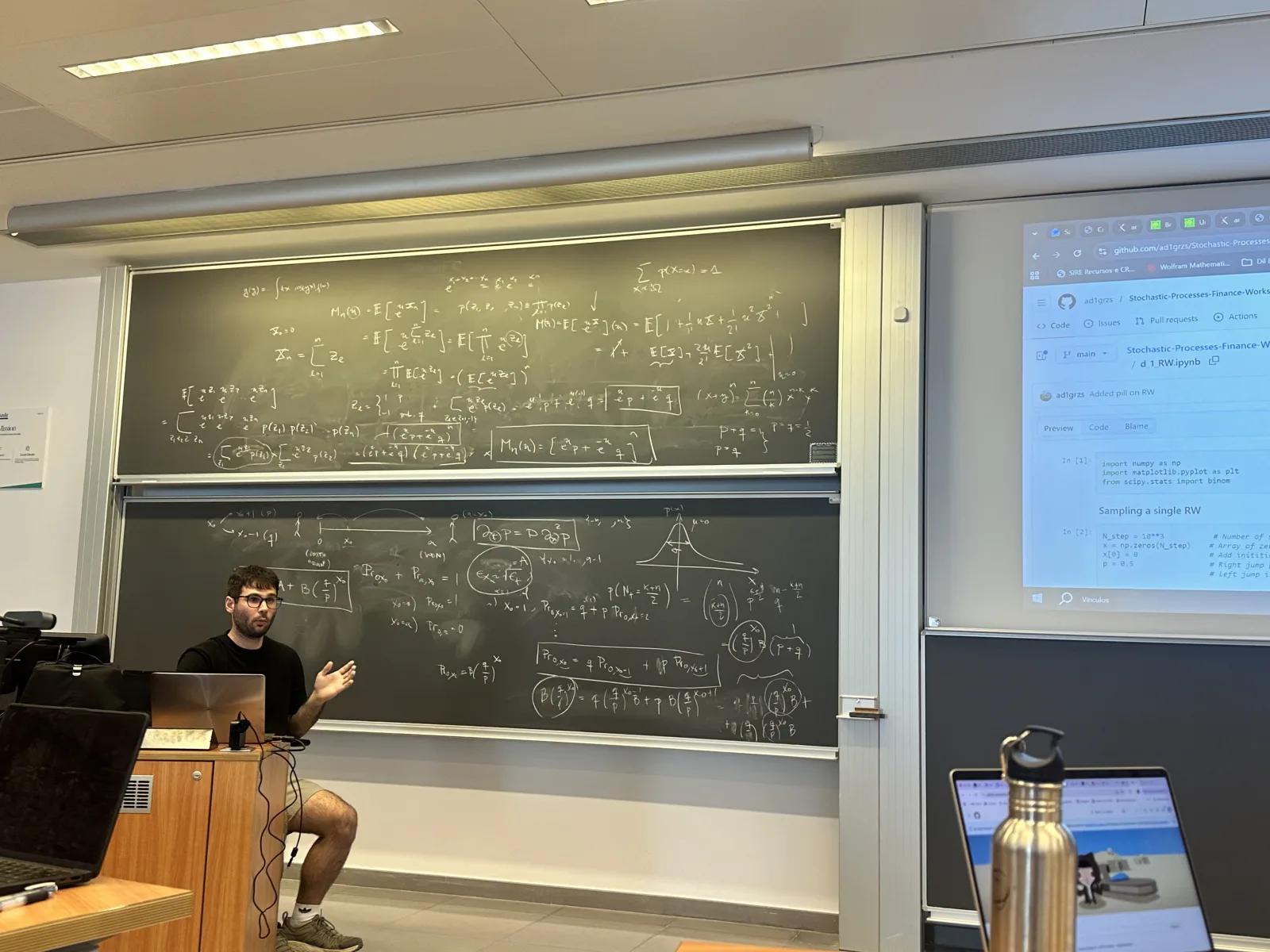
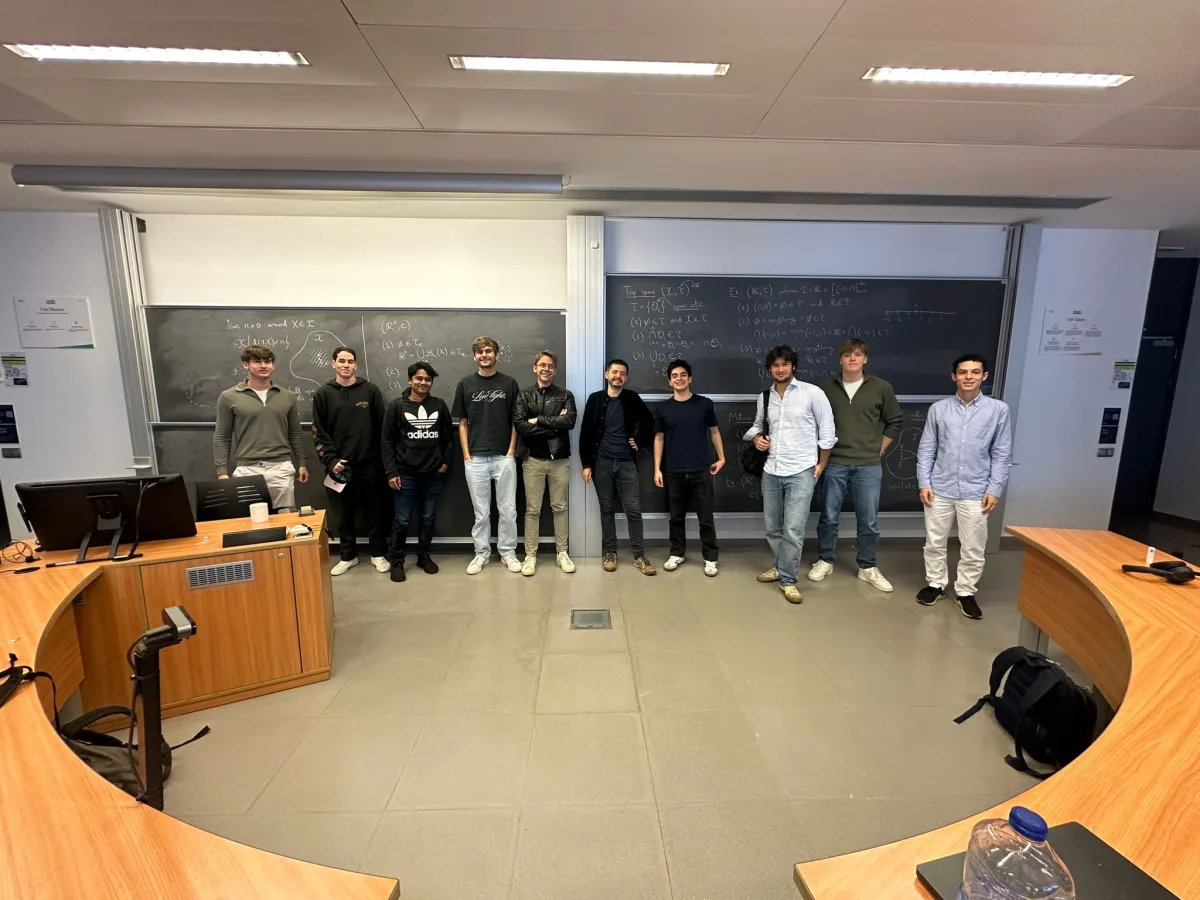
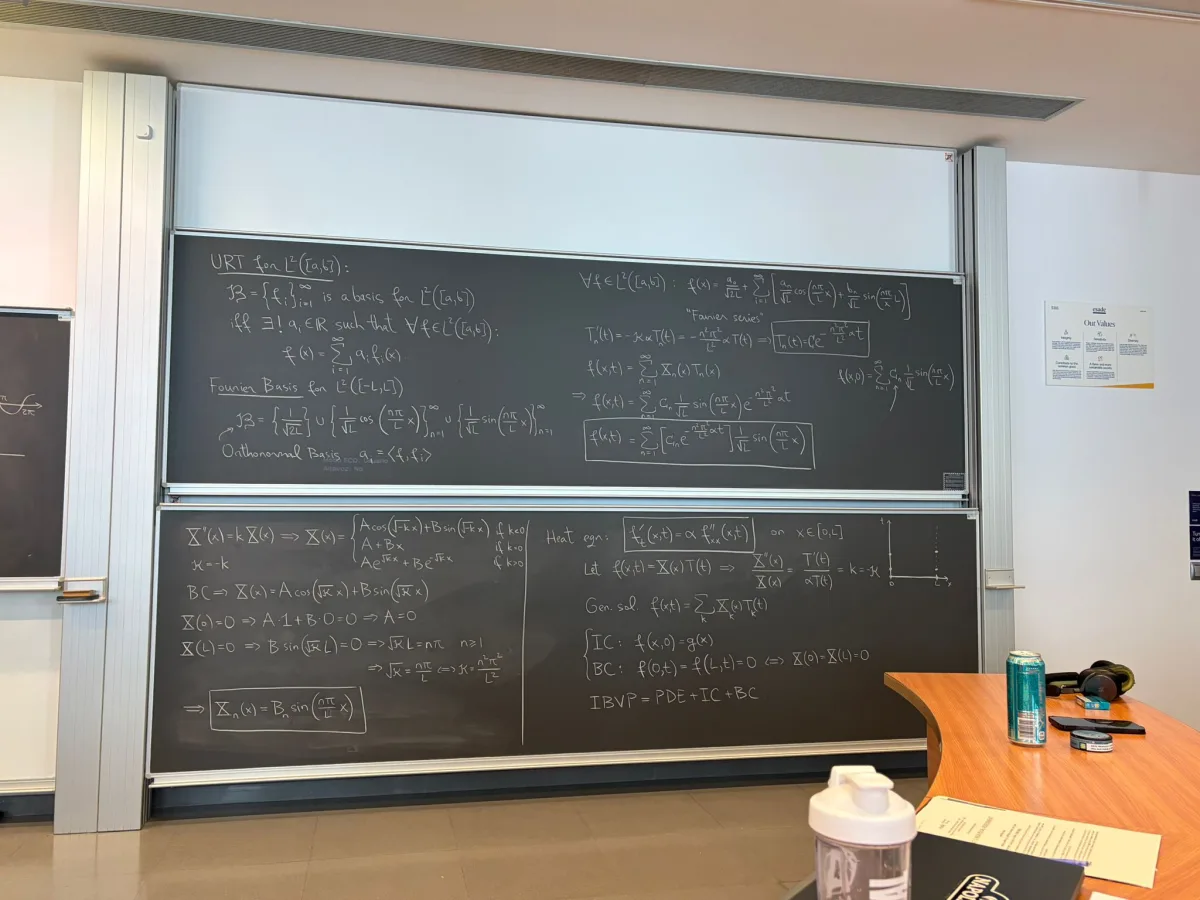
The life of the law has not been logic: it has been experience.
A new department, taking shape at ESADE Pedralbes.
Law, technology, and the institutions they touch.
You do not need to arrive as a researcher or a quant. Bring engagement, initiative, and the willingness to put in the work.
What I cannot create, I do not understand.